Friday, May 6, 2011

Amsterdam: bicycles, canals and fields of orange

My first impression of Amsterdam was by way of Schiphol, Amsterdam's airport. Schiphol actually has an interesting story: it was built on a lake which was prone to violent storms that often resulted in the loss of many ship and it garnered its name from this as Schiphol means "Ship's Grave" in English. Regardless of the origin of the name, I found Schiphol to be incredibly clean and modern looking. This theme continued all the way to Amsterdam which with it's buses, trams and many bicycles felt like a very different sort of European city.

From the airport we took a quick train ride to Amsterdam itself and then went to our first hostel which was located in the heart of the Downtown area. As we incidentally ended up in Amsterdam for the days leading up to Queen's Day, most of the hostels were very booked up and we were forced to book two (one for the first night, another for the rest of our trip).

As Amsterdam was the last stop on our European tour and we all felt the hole burning in our bank-accounts we went for a very inexpensive lunch, choosing to have falafel which turned out to be a great choice not just for our pocket-books but also for our taste buds. Our first night I was also able to see just how wonderfully oriented Amsterdam was to bicycles. The others found them to be dangerous for pedestrians but I marveled over how unique it was to be in a city where there weren't just bike lanes but almost separate roads, stop-lights included, for bicycles. Coming from the US it was incredible to see a city where bicycles weren't just a mode of exercise and enjoyment but the most practical way of transportation.

One of the many canals of Amsterdam.
The next morning we checked out from our hotel and then trekked across the city, which is actually relatively small, to Uptown where we left our bags at our new hostel and wandered back into town until it was time to actually check-in. Check-in itself took far longer than any of us liked with a ten minute wait turning into over a half-hour wait. We were all irritated at seeing four people at the reception desk and not one of them helping us when it was clear that one of them was able to do so. Regardless we finally did check-in and were glad to find that the bunks in our rooms were comfortable and also came with towels (often a luxury in hostels).

The group of us were somewhat split about what to do next but Kendra and I decided that we'd be foolish not to visit the Van Gogh museum which was a street over from our hostel. I was actually glad that only Kendra and I explored the museum as we could look and think at our own pace and also seemed to appreciate Van Gogh on the same level.

 I've already written about how I really fell in love with Van Gogh when I visited the Musée d’Orsay in Paris but in between that weekend and my vacation I had also read a work of fiction called Leaving Van Gogh which focused on the last year of Van Gogh's life. The concentration of Van Gogh was purely accidental but I found my accumulated knowledge to really hit home how interesting, unconventional and tragic Vincent Van Gogh's life was.

An actual stop-light for bikes. If only we had these and their
accompanying roads in the US.
As for the Van Gogh museum, it was divided chronologically, moving from one period in Van Gogh's life to another. I thought the museum's decision to include work from other artists, to show his influences, to be particularly powerful as it highlighted his choices in color (Japanese prints) and also his varied styles. Before leaving we each bought Van Gogh mugs, Kendra's with sunflowers and mine with almond blossoms.

For dinner we had tapas which was new for most of us but still delicious. The next morning we found another bagel shop, which we treasured, and then mostly wandered around the city. Among many things we stumbled upon the famous floating flower market which is on the Singel, one of Amsterdam's oldest canals. I didn't realize until I was back in Dijon that it is called a floating flower market because all of the tulips are displayed on barges and not just simple stalls like I thought they were!

I was actually quite surprised by how easy it was to navigate a city that has an impressive network of canals but where Venice's canals had a much more winding feel, Amsterdam's were actually constructed so that they formed consecutive rings that moved outwards and are incredible success of city planning. While walking over the canals I found myself thinking of how the Netherlands was once one of the most powerful trading empires in the world. I think many people these days, myself included, have a tendency to forget that before the British East India Company there was the Dutch East India Company and that the merchants and the Dutch Republic were very influential on world affairs.

Just a glimpse into some tulips of the Keukenhof gardens.
After wandering and exploring some more we had burritos for dinner and then set out to find a night tour of the canals. We had some minor difficulties finding the right company which was affiliated with our discount ticket but eventually did and despite some rain and lightning in the distance had our tour which gave information about the history of Amsterdam and its canals. On the tour I was particularly interested in the house boats which are capped at about 2,400 but which I would absolutely love to live in.

The next morning we rose early but gladly in order to visit the Keukenhof flower fields. Originally we had thought of renting bikes and then riding out to the tulip fields but the practicality of this turned out to be more difficult as the Keukenhof gardens were too far away from Amsterdam to ride on town bikes. Instead we signed up for a tour of the gardens through a company which provided entrance to the gardens and transportation but then left us to our own devices. As the largest flower garden in the world and with more then seven million tulip bulbs planted the Keukenhof gardens were a veritable feast for the eyes filled with tulips of all different colors and varieties. We had no trouble at all walking through the paths and enjoying seeing thousands of tulips many of which were arranged to form patterns.

I was having more camera troubles throughout the gardens, of the dust-in-the-sensor type, so took some photos when my camera was cooperating but will link you to the garden's official flickr so that you can see how Van Gogh the flowers were like in uniqueness and vibrancy.

When we got back to Dijon after our visit to the gardens our first mission to see was the Anne Frank house. We didn't have any intention of waiting and paying in line (perhaps another day) and had hoped to just see the house from the outside but it was rennovated for the purposes of the museum and seeing as how Anne Frank and her family hid, the most important parts were on the inside.

Buildings on the edges of Amsterdam's canals. Sadly the lovely
differences are missing.
That night also happened to be Queen's Night, the evening before Queen's Night. Queen's night or Koninginnedag is the Dutch national holiday that celebrates the birthday of Queen Beatrix. Her actual birthday is in January but the holiday remains April 30th in honor of her mother and also because the weather is better. We sadly left on Queen's Day but did get to see some of the craziness of the night before which is mostly filled with a lot of orange (the national color) and a lot of drinking.

Due to all of the anticipated craziness of Queen's Day we rose and checked out early so that we could get to the Schiphol train station early in case of any major delays or incidents involving public transportation. There were no difficulties getting out but we did run in to many people who clearly thought we were crazy for leaving on the biggest holiday. One man at the train station even told us that it was "unfortunate" we could not stay in Amsterdam for the festivities but that we were "wise" for leaving early.

As our train was in the afternoon and we couldn't change it without lots of fees, we ended up waiting in the station for a good period of time and amused ourselves with cards and also with watching all of the orange clad people run around the station on their way to the city. I was sad to miss what was clearly a very fun day but was glad that my last impression of the city was one of national pride.

Wednesday, May 4, 2011

Prague: of great conversations and inspirational walls

We had no problems with security at the airport on our way to Prague (Praha in Czech) but Kendra and Sean's bags were deemed to be too large, even though they weren't, and they had to check both of them and also pay a 38 euro charge. Despite this annoyance both our bodies and our bags arrived safely in Prague.

The Easter market in Old Town Square.
It took a bit of time to figure out the currency exchange, as 1 USD is about 15 Czech crowns, and then had a bit more trouble trying to figure out how to get from the airport to the hostel but by 9PM we had arrived at our hostel. The hostel itself had an incredibly friendly atmosphere which made up for the awful service we'd had in Rome. One man at the hostel named Isaac even drove us into the center of town and then to the beginning of a pub crawl.

The pub crawl itself began in the basement of an old and no-longer-in-use medieval church and certainly set the mood for what Prague as a city would be like. Somehow or another games began with some English boys that were there and both English and American national pride were tested via such games.

The Charles Bridge, buzzing with people, on a sunny day.
As we walked to the next bar I found myself, as I do, in a conversation with one of said English boys about history, politics, environmental issues and each of our own countries. I don't think anyone would have a very difficult time believing that I found it to be a fantastic conversation and a great part of the evening. Unfortunately, I did not have similar conversations with the other English, one of them telling me (along with many other very bizarre things) that because I wore my hair in a plait (that's braid in American English) I was "practical" and "organized". Said person also turned out to be incredibly creepy and I had to be continually saved from him by either Michelle or Amy.

Beatles inspired graffiti on Lennon wall.
When the night was over we ended up having to take a taxi back as our hostel wasn't located in the center of the city and for newcomers Prague can be incredibly confusing to navigate. The taxi also made dealing with some of the more inebriated members of our party a bit easier.

The next morning after using the internet for the first time in a week (I spent the majority of the time searching Nikonians for any help with my camera) we set out to explore the city. Prague itself is a wonderful mixture of old and new. The center of the city is largely old with gorgeous architecture and wonderful winding streets. Although Prague's streets were much better labeled than Rome's, I found them much more difficult to navigate and we ended up walking in directions we didn't always intend to see.

A message pasted on to Lennon wall.
We were; however, able to profit from the Easter market set up in Old Town Square. All across the square little booths were set up selling everything from sausages and beer to trdelnik (unleavened dough, sugar, almonds and nuts baked on a rolling wheel). It was a fantastic way to eat cheaply but also relatively well while on the go. Old Town Square was also where the famous Astronomical Clock was. The clock in question displays the time, the different symbols of the zodiac and every hour on the hour there is a procession of the twelve apostles. We didn't end up seeing the procession until our last full day in the city but we were able to marvel at the intricacy of it.


From Old Town Square we made our way (or attempted to, it took a little while) to the Dancing House. The building is designed to look like a pair of dancers which is why its other nickname is "Fred and Ginger" after Fred Astaire and Ginger Rogers. After we went to the Charles Bridge, the oldest bridge in Prague but also the most mobbed during the day. It took quite a while just for us to get from one side to the other not because of distance but because there was such a mix of artists selling their wares and tourists. Eventually we did get across and found a place to sit and relax, first finding a bench and then finding a park.

After, graced with coupons to the Hard Rock Cafe, we went back into the Old Town and had dinner. I'd never been to a Hard Rock Cafe and don't particularly find it the most fascinating restaurant in the world but still enjoyed the food and seeing the various guitars and outfits of singers and bands. Kendra and Sean went on another bar crawl that night (when in Prague, I guess) but Amy, Michelle and I stayed in and while I was able to catch up on my journal I also sewed up a hole in Amy's pants.


The next morning was sadly a slightly rainy one but we still went out to explore with our sole goal of finding the John Lennon wall. The wall itself was once a normal wall but during the 80s various graffiti relating to John Lennon or the Beatles began to crop up. At this point in time the Czech Republic was still part of Czechoslovakia and under Soviet control and the wall helped to increase tensions between students and the police which lead to skirmishes on the Charles Bridge. The wall today is constantly changing, with all of the original illustrations and writings covered up with new ones. When we were able to find it I we spent a good deal of time just wandering next to it looking for little messages based on Beatles lyrics or peace in general.

For lunch we stumbled on a bagel restaurant and all gladly bought toasted bagels with cream cheese, an American treat we've all missed in France and the rest of Europe. Our brief union with "American" food continued with Starbucks where the others bought American-size coffees and I enjoyed tea.

This piece in particular was one of my favorites.
Luckily for us the Easter market continued into the evening and we were able to grab some inexpensive but very filling food there. That evening was another bar crawl which was less fun than the first (no conversations about history) but did yield us meeting some French engineering students one of whom invited me to visit him in Nancy and also proved how horrible the French are at dancing.

The next day we slept in and packed for our move to Amsterdam. Breakfasts were free at our hostel in Prague but halfway through eating our toast one of the guys at the hostel (Noah) asked if any of us wanted pancakes. We all said "yes of course" and enjoyed the crepe/American-pancake fusion that he made for us.

After checking out we caught a bus that took us directly to the airport where we waited to board our flight and also spent the rest of our Czech crowns on food and treats. All in all Prague was a beautiful city which was simultaneously old and new and having visited it I can see why it is a destination more and more people are going to.

Tuesday, May 3, 2011

The Roman saga

Tuesday afternoon was largely spent on a train headed towards Rome (Roma in Italian). We had some minor difficulties getting to our hostel because the streets in Rome are either horribly labeled or not labeled at all. After buying a map and using what was basically a process of elimination, we found the road that our guest house was one and then set off to it.

As for the guest house it was on the 7th floor of a building that was at the time (and probably still is) constructing an elevator. We were supposed to have three rooms but for some reason only got two, though for some reason there was no difference in price. One room was a double with a cot and the other was simply a double. It was nice not to be in bunks but our bathroom shower was very small and flooded often.

A small section of the Colosseum at night.
After settling in our rooms we set off in search of food and didn't have to go very far to find a nice place to eat. I had pesto linguine and shrimp which was amazing, although pesto is one of my favorite additions to food of all time and I didn't expect to be disappointed by it in Italy. The pesto itself was actually rather light and didn't particularly taste like pesto I've had before. It was delicious but the basil and garlic wasn't as strong. As usual we split a bottle of red wine and enjoyed the fact that we were in Rome.

A glance into the Colosseum at night.
I continued my role as map keeper and so when I saw how close we were to the Colosseum I suggested that we go to see it after dinner. Sure enough only a few streets down from our restaurant, I looked to the left and saw a section of the huge amphitheater looming in the distance. The canals and David certainly drove home that we were in Italy but I think seeing something as massive, ancient and iconic drove home the fact that not only were we in Italy but also in the city where one of the most powerful and influential civilizations began (and died).


When we got close to the Colosseum many pictures were taken (as is obligatory) and when we finally got down to street level I tip-toed unnecessarily up to one of the huge columns, touched it and then hugged another. I expected the Colosseum, originally called the Flavian Amphitheater, to be massive but by seeing it in person I was struck by how old and impressive Rome was (and is). Granted, many of the places that I personally found most impressive were also the oldest, but in combination with the Foro Romana which sits right next to the Colosseum, I was very much in a state of awe.

Kendra also jokingly said that I was a terrible history major for not being able to site the age of the Colosseum or other bits of historical information related to ancient Rome and I feigned hurt as Ancient History is quite a ways away from my focus. We didn't quite get our fill of the Colosseum but because night tours don't exist (they should!) and because some of us had to use the facilities, we left and on the way back to our hostel got gelatto.

One of the many waterfalls/fountains at Villa d'Este.
The next morning we had breakfast at a cafe right down the street from our "guest house" which was free with our rooms - well a pastry and a hot drink was - and then began our first full day in Rome by leaving it. Our destination was Tivoli which is about an hour outside of Rome by bus and the town where Michelle's family from. We were headed in particular to Villa d'Este which was the home of some of her ancestors. Villa d'Este has expansive gardens with some truly incredible fountains and waterfalls. As far as an ancestral home goes it was top notch and we couldn't turn down a path without seeing something gorgeous or intricate.

After visiting the Villa we bought cheap sandwiches from a woman who couldn't speak any English that were OK but did the job of satisfying our hunger. We attempted to go for gelatto afterwards but found that everything was closed and subsequently headed back to Rome. In all the metro and bus to Tivoli cost 6 euros round-trip and was without a doubt worth it.

An arched open-air passageway with wisteria in Villa d'Este.
Upon arriving back in Rome we made our way towards the Trevi Fountain. The Trevi Fountain itself is the largest fountain in all of Rome and one of the most famous in the world so it is also subsequently one of the greatest tourist traps in all of Rome, certainly one of the greatest I saw throughout our trip. All of us simultaneously made wishes while throwing in centimes and managed to get away without being accosted by too many people who attempt to sell crap at every popular site.

From the Trevi Fountain we walked to the Spanish Steps which are accessible from the Piazza di Spagna. An apartment next to the Spanish Steps was also where John Keats spent the last four months of his life and now houses the John Keat's museum. We went in to find out how much the museum cost (4.50 euros) and what exactly the museum was but when we were told it gave information about his life, manuscripts and then locks of hair (which is just weird) we decided there was nothing there that couldn't be found in a book or on the internet.

The Trevi Fountain.
Tired and hot we headed back to our "guest house" and after a rest headed for dinner. Kendra's research on Rome yieleded something called the Piazza Crawl alternatively known as Piazza Navona which has three fountains, the largest of which was designed by Bernini and featured in Angels & Demons.

On the way to Piazza Navona we passed by many sites including more of the Foro Romana; the monument to Vittorio Emanuele II, where the Italian equivalent to the tomb of the unknown soldier lies; incidentally walking upon some sort of ceremony that was compromised of a speech, a concert and Roman soldiers (in full ancient costume); and the Pantheon. It was another moment that highlighted how we had such incredible luck when it came to places we planned to go to and places that we stumbled upon.

Dinner at Piazza Navonoa was amazing and made even better by our hilarious waiter who made jokes and references to the Boston area (I haven't met one person who really knows what New Hampshire is), joked about Sean being a ladies man and then flirted with Michelle when he walked past our table as she was on the phone with her boyfriend. Towards the end of the evening he stopped and said that if he married Michelle they could spend 4 months in Tivoli, 4 in Rome and then 4 months on Cape Cod. We also had excellent wine that was our least expensive to date, pesto (again but with a stronger basil taste) and enjoyed our incredible setting. It was very relaxing and we took our time eating, drinking our wine and just sitting.

As we left the restaurant a street busker started up with a remarkable rendition of "Hallelujah" and then continued to sing five or six more songs. His voice was amazing and we sat by a fountain for each one marveling at his voice, his choices in song renditions and our luck. When he was done (and after we dropped some euro coins into his guitar case) we walked around the rest of the fountains which were all lit up for the night and then made our way back to the hotel. Altogether the day and evening combined was incredible and perhaps the best day of our entire trip.

The Spanish Steps at Piazza di Spagna.
Our next day was reserved for the Vatican and because we have a mixture of good and bad luck we ended up being in Rome for a part of Holy week. This mean that we somehow made it into Saint Peter's Basilica as mass was beginning and therefore saw many bishops, a few cardinals and oh! the Pope.

It personally felt incredibly strange being in the center of the Catholic Church and seeing the head of said church while being neither Christian or Catholic - though not atheistic. I could appreciate the Vatican for its architecture and art but could only really appreciate the religious aspect in relation to the effect it had on others. It was very surreal to see the Pope but it was much more the atmosphere of seeing him - thousands of people, hundreds of camera and people of all races and backgrounds - then seeing someone that was personally important to me.

Of course because it was Holy week some things were a bit off schedule. We had wanted to do a tour of the Necropolis (crypts beneath the Vatican) but due to Angels & Demons only 200 people could visit per day and during Holy week the crypts were actually closed. A large part of St. Peter's was also closed during mass and we were unable to see about 3/4 of it including Michelangelo's Pieta.

The monument to Vittorio Emanuele II.
We later found out that after mass finished (and I should note that in St. Peter's square the entire mass was televised on jumbo-trons), St. Peter's would re-open. Until then we decided to go to the Sistine Chapel and therefore the Vatican Museum.

The museum, or at least the line, was host to many people with so called "skip the line tours". I'm sure they would have cut the line shorter but they would have also cost four times as much and been guided. I have nothing against guided tours and in fact enjoy them some of the time but none of us wanted to go on any and really did not appreciate being harassed by people that were selling a product.

Luckily the line moved relatively quickly and thanks to being students we got discounts on the entrance fee. As for the Vatican Museum, I found that it was essentially a labyrinth that takes one through elaborate rooms with Church paintings that were commissioned by a Pope. I'm not particularly fond of religious paintings but I did appreciate their importance in relation to Art History and also History in general. In this vein it was very neat to see an entire hall dedicated to painted maps of rooms credited to the notorious Borgia family.

Another look at the monument to Vittorio Emanuele II.
Our final destination in the Vatican Museum was our real reason for being in there at all: the Sistine Chapel. As Michelangelo's first fresco it was incredible and as a fresco in general it was very impressive. I craned my neck to see the scenes painted on the ceiling and for those intermittent seconds that it hurt my neck I can't imagine how painful it would have been for Michelangelo who lay on his back for years just to paint it.

After the Sistine Chapel we navigated the Vatican maze once more, although this time to leave, in search of food because we were all exhausted and famished. Due to this we ended up eating directly across from the Vatican at a grossly overpriced cafe. The food wasn't worth it price wise but we were hungry, tired and sitting down to eat was sort of made up for it.

From the cafe we headed back to St. Peter's to see the status of the line and to also see if we could take a tour of the Necropolis (which we later found out was closed). Michelle and Amy left to find a park as they didn't want to wait in line while Sean, Kendra and I waited to re-enter St. Peter's. The line was thankfully very fast moving and we entered very quickly, first choosing to take a tour of the tombs of the Popes which obviously house the tombs of many Popes but also house several members of Royal families who were exiled for being Catholic. I found it interesting that there was a Stuart tomb particularly after having taken a Tudor and Stuart England class the last semester.

I'm such a sucker for pictures of ordinary streets or roads in cities or towns
and could not resist snapping this on our way to Piazza Navona,
particularly as the near-sunset light was lovely.
From the tombs of the Popes we went back into St. Peter's. Upon seeing it open we realized how little we saw during mass that morning and how truly massive it was. We were also able to see Michelangelo's Pieta which is kept behind bullet-proof glass after a madman took off a finger and a nose (now restored). While the detail of Michelangelo's David was impressive, the folds and intricacies of the Pieta were almost incomprehensible given what precision must have been necessary.

That evening Sean broke his cot just by sitting on it. All of us were in a state of shock but finally told the proprieter who glared at Sean and then promptly went to find zip ties to fix it. The quick manner in which she went about "fixing" the cot made all of us think that it had happened before and for the rest of our visit in Rome Sean was on edge about breaking the bed again even though the first time it had not been his fault.

The next day was personally very rough for me mostly because when I entered the Colosseum my camera began to freak out, citing dozens of errors, telling me the lens was not attached when it was and then making me think that it had died. That morning my bottle of water (which the day before I had filled with safe drinking water from one of the Vatican fountains - oh the irony) spilled in my bag but as my camera rested above the water bottle and it took a picture without any difficulty after the spill I figured that there was not a problem.

My picture of the Pope came out a bit blurry so here's one of what I believe
are the bishops. As soon as their was movement everyone's cameras
flew up and I knew that the Pope was there not because of his hat or his
small size but because everyone was such in a frenzy. 
To this moment I still don't really understand what happened. Seeing as how my camera worked fine afterwards I'm not sure if it was due to water damage but nevertheless my camera essentially died in the Colosseum and I had a meltdown as a result of it. I remember quite clearly sitting on steps outside of the Colosseum and noticing people with cameras all around me, in particular those with the iconic Nikon camera strap, and wanting to say "I have one too! It's just not working!" Given all the problems, I walked through the Colosseum in a nervous/near breakdown attitude unable to really appreciate it while I thought my camera had died. The feeling followed for the Foro Romana and no amount of removing the battery and re-attaching the lens resulted in it turning back to normal.

The camera later ended up working but only when both my lens and camera where on manual. I was able to take photos as long as I completely controlled exposure and also personally focused the camera. I was unfortunately forced to remove the battery whenever I turned the camera off as it continually flashed me a green light that resulted in the camera sapping battery life. Though the camera was able to take photos manually later that day I was still really depressed.

The moment culminated when during lunch my apple rolled down the hill and nearly went into the road. I instantly burst into tears and when someone said "I'm sure the apple will be alright", I sobbed "It's not the apple!" A day later I would laugh about this but at the moment the apple was everything that had gone wrong on a day that could have been really wonderful.

Inside St. Peter's with the afternoon light shining through.
For dinner we went to the same restaurant as our first night which was a good choice as the food was once again incredible. Afterwards we went out and Michelle, Amy and I discovered what Kendra and Sean had found the night before: DNA, alcoholic water which tasted a bit like carbonated Poland Spring, a bit like lemonade but was devoid of any alcoholic taste and were it not for the label none of us could even tell it was alcohol.

That night I also accidentally locked myself in the bathroom. It took a good two minutes to get out and when I did the proprietor was there glaring at me as if the problems with her door were my fault. She ended up removing the key so that none of us could lock it which frightened all of us as many Europeans have a habit of not knocking on doors before entering.

The next day was our day to leave and we were glad to be rid of our "guest house". While our stay in Rome was fantastic, the guest house was the worst of our entire trip and we all pledged to give it horrendous reviews. We checked out, got breakfast and then set ourselves up for a few hours of wait in a park where it just happened to be the time when all of the dogs were there. Some of them came over to see and play with us and all of us, feeling nostalgic for our own dogs, had a lot of fun play with them.

For lunch we bought some snacks, I finally had a cannoli and we headed for the airport.

Monday, May 2, 2011

Florentine adventures

Despite reports that Italian trains were incredibly unreliable, our train from Venice to Florence (in Italian: Firenze) arrived and left right on time. Of course while the train itself was without issues, the train station was much more confusing and for a while we had a hard time just figuring out where to buy tickets for Rome and then where to catch the bus to get to our hostel.

Nevertheless we prevailed and found our guest house without too much trouble. I had taken the liberty of buying a map of Florence (I did the same in Venice and sort of continued this habit throughout our trip) and therefore was the self-appointed navigator. After check-in we went in search of food which turned out to be only slightly difficult as it was a Sunday and there were not too many restaurants open. One restaurant was suggested to us by the proprietor of the guest house but without a reservation there was not enough room for five. Luckily we only had to go a bit further down the street to find some good Italian food. Like France and its food, I don't think we could have gone wrong wherever we went but I still enjoyed some delicious ravioli with walnuts and cream sauce which, apart from the pasta we cooked in Venice and the pizza we ate, was our first real meal in Italy. Verdict: delicious.

Ponte Vecchio in full morning sunshine. I insisted on walking to the
other side so that I could get a photo in "proper-lighting" and was
very pleased with my result.
Where in Dijon all museums are closed on Tuesday, in Florence (and possibly the rest of Italy) they are closed on Mondays. This meant we couldn't go to any museums on Monday. In lieu of museums we simply did a little bit of exploring, visiting Ponte Vecchio, a medieval bridge that still has shops built on it which was at one time the common practice; Piazza Della Signoria and Piazza Del Duomo. We waited in a very fast line to go inside Santa Maria del Fiore which is increidbly ornate and majestic on the outside but not particularly impressive on the inside. We considered going to to the top of the Duomo which offers a magnificent view of all of Florence, as well as a peak into the hills of Tuscany, but the line was obscenely long, very slow and it would have taken hours just to get inside let alone to the top.

Instead we popped back to the guest house to pick up a few things that were forgotten, like a camera battery (not mine) and after a bit of rest we set back out, heading for the massive market by Saint Lorenzo. As far as markets go it was not my favorite because there wasn't much variety between sellers who sold similar looking leather jackets, leather bags, scarves and jewelery but it was still fun to walk through.

Afterwards we got lunch and then attempted to go to Piazza de Pitti and the many gardens there but when we discovered that entry cost 10 euros decided it wasn't worth it and instead took a bit of a nap on the area in front of the Palace.

Dinner Monday night for me was not quite as good as Sunday's probably because it wasn't a family restaurant but I did enjoy the tiramasu and afterwards we all felt like we were in a very satisfying food coma. After doing some last minute research regarding Gallera Dell'Academia Monday evening, on Tuesday we set out early to get in line to enter the Galleria. This was necessary as in Florence the lines are incredibly long to enter museums and reservations (when possible) are strongly recommended. We had looked for openings for a reservation but found none and instead braved the lines. We were rewarded for our early rising and by the time we reached Academia, we rounded out the first 10 in line.

A street artist works on a reproduction of Girl with a Pearl Earring.
Academia is most famous for housing Michelangelo's David but other than some of Michelangelo's abandoned projects and religious paintings, there isn't very much to see. David was very much worth the entry and I found the statue to be incredibly impressive and much larger than I had thought. As we were some of the first in the museum, Academia was not crowded and we could admire David without being pushed or feeling to hot. As far as sculpture goes it was striking and I found myself marveling over how even the veins on  David's hands and neck were defined. As sculpture can't exactly be retouched it was amazing to see such a massive statue in perfect detail.

After Academia we headed towards the Duomo, actually a part of Santa Maria del Fiore, which thankfully had a very small line but which grew to be much longer about 10 minutes after we got there. The climb up wasn't too bad except for the parts where people were also coming down. I was able to sort of squeeze into a corner but still felt slightly violated by the hordes of people who pushed past me to get down. As for the Duomo, it offered a great view of all of Florence and I can imagine that were it less smoggy the Tuscan hills would have been beautiful to see.

On the way back from the Duomo to the guest house we stopped at a cafe to get some fruit cups as we hadn't really had much to eat for breakfast. The fruit was good but when we received the bill and found that the fruit cost 10.80 I was a mixture of shocked and livid because the prices were hidden and the fruit was not worth nearly 11 euros.

As for checkout, it was a little confusing mostly because a time was not specified and we did not pay upfront (which felt quite strange on our arrival) but everything worked out. The only trouble was what to do afterwards with all of our backpacks and a train at 4:40 in the afternoon. We attempted to find a park and relax in, as we had done in Venice, but discovered that you have to either pay to enter a garden or a park or they are private. Apart from how ridiculous this was in principal, it resulted in us walking from garden to piazza only to find out that the garden was private or that the grass couldn't be sat upon.

In the end we parked ourselves on the grass outside of the train station, got some pizza (always good) and then went back to the grass by the station until our train till Rome came.

Overall Florence was a beautiful city with rich history in art but one I think I would have enjoyed more had I taken a day trip to Tuscany and seen the beautiful countryside.

Apologies for the lack of photos of Florence, I promise more will be coming with Rome!

Sunday, May 1, 2011

Venice, the impossible city

Having returned from my travels around Europe (Italy, the Czech Republic and the Netherlands) I suppose I can now say that I am a world traveler, one with great memories, some filthy clothes and a broken camera. As I spent two weeks traveling I'm going to post an entry for each city that I visited so that each place can have the proper amount of attention. I brought along a moleskin journal to write in so that I wouldn't forget little details and also not have to write a novel all at once.

That said, here is Venice (Venise in French, Venezia in Italian):

Our trip began with an overnight train from Dijon to Venice. On our trip to Nice we tried our best to sleep in train seats that reclined but for our night train to Venice we were blessed with a sleeper cabin. I should probably amend the usage of 'blessed' mostly because the compartment itself was a little hot and uncomfortable (I could not sit up while sitting in bed) but it was great to have a place to sleep and when we woke up I felt quite rested. The only strange part of the train ride was that when our tickets were checked, the conductor took our passports telling us that he would return them when he woke us up the next morning. We did get our passports back the next morning as promised but I found myself anxiously awaiting the return of my passport which is the one essential object that should never leave your sight while traveling. 

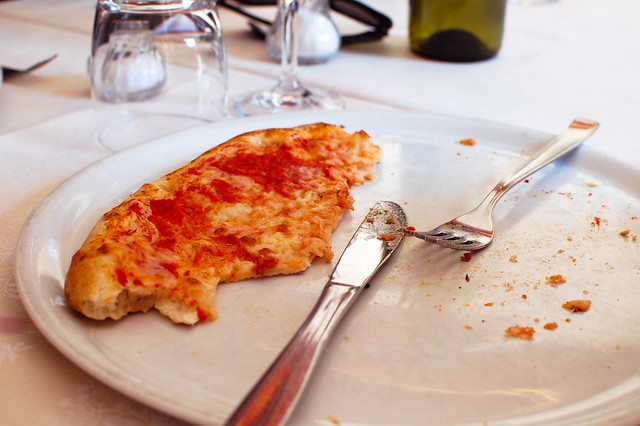
The remnants of our last meal in Venice.
Our ticket brought us to the station right before Venice so we had to buy a 1 euro ticket just to get to the actual station. Once we arrived in Venice itself we bought our tickets to Florence so that we wouldn't have to worry about it and then set about figuring out how to get to our guest house. When the only transportation possible ended up being a water bus I knew we were really in Venice, a truly impossible city.

I had another moment or realization at lunch when as we began to eat our pizza (so delicious!) an accordionist began playing a few feet from our restaurant beginning with "That's Amore". It wasn't exactly a stereotypical moment but it was certainly the image - or the moving picture - of a meal in a beautiful Italian city. All of our jaws dropped and we were split in finding the situation hilarious and also incredibly appropriate.

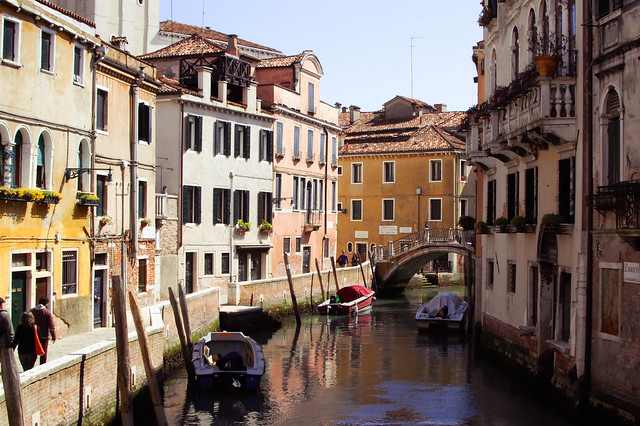
A street view, or rather canal view, in Venice.
As for our guest house, we dropped our bags and paid after our arrival, got lunch (as described above) and then gelatto and then finally checked in. The guest house in question ended up having more than any of us had pictured. It was new and so there weren't any reviews but we were happy to find a bathroom, five beds and then the real treat: a small kitchen.

We did a little shopping (in Venetian masks and glass) and walking around and then bought pasta (incredibly phallic and bought from a regular grocery store), a pepper, garlic, olive oil and some Parmesan cheese which we brought back to the guest house to make pasta that night. Dinner as a whole was delicious but also incredibly hilarious due to the phallic pasta which still makes us laugh two weeks later.

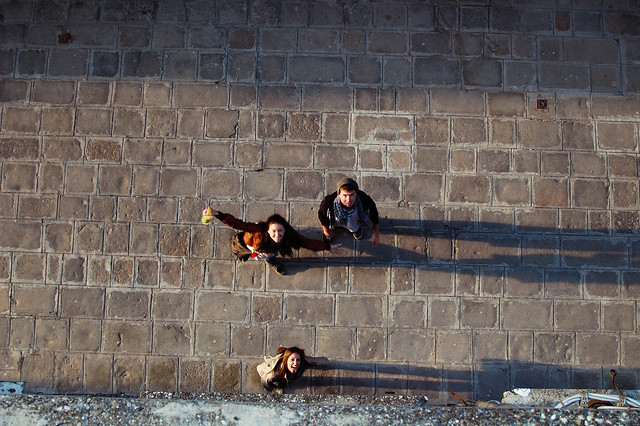
Sean, Kendra and Michelle, taken from our guest house.
When dinner was over we headed out in search of a gondola ride. At first we were nervous that we might not find a gondolier because most boats were covered but we were able to find one and went on an incredibly peaceful and lovely ride. The next morning when we saw gondolas that were caught up in a water-way equivalent of a traffic-jam we were all glad we had gone at night not only because it was more picturesque and also because it was more private. The only complaint of it, although also a point of amusement, was that the gondolier briefly talked on his cell-phone while steering us around the canals.

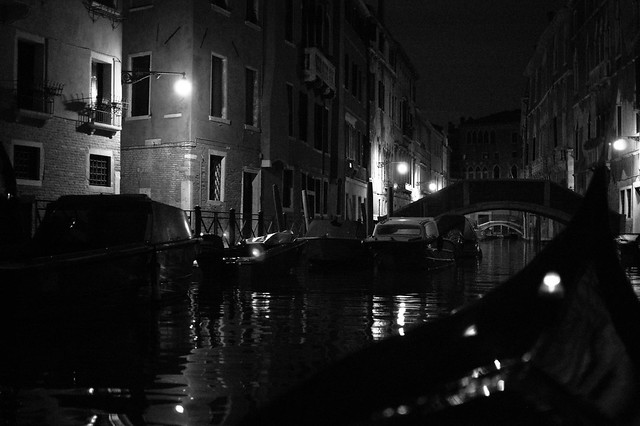
From our gondola ride.
The next day we were supposed to check out and then get breakfast but no one was there to check out so we left our bags in the room/suite and went in search of breakfast. I had an omelette and tea but Sean, Kendra and Michelle all enjoyed their various forms of Italian coffee. Afterwards we checked out without any difficulties and then spent the beginning of the afternoon wandering around the city. Our first day we enjoyed a quieter, almost more artisan side of the city but Sunday we walked past many designer stores and enjoyed the many bridges and the weather. 

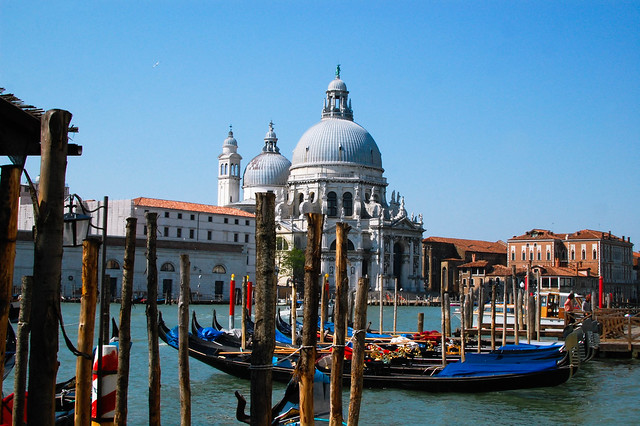
Looking towards the Grand Canal with gondolas in the foreground and
Santa Maria della Salute behind it.
We also stumbled on a sort of antique market by a church that was exhibiting old string instruments in memoriam of Vivaldi who spent the majority of his life in Venice, contributing to its rich musical history.  Afterwards we headed back one last time to the hostel where we picked up our bags and made our way by water-bus to the train station. Near there we found a park, made PB sandwiches and played card games until it was time to catch the train.

Overall our stay in Venice was lovely and by staying out of the high traffic areas it was quiet and very enjoyable, a perfect start to our trip.
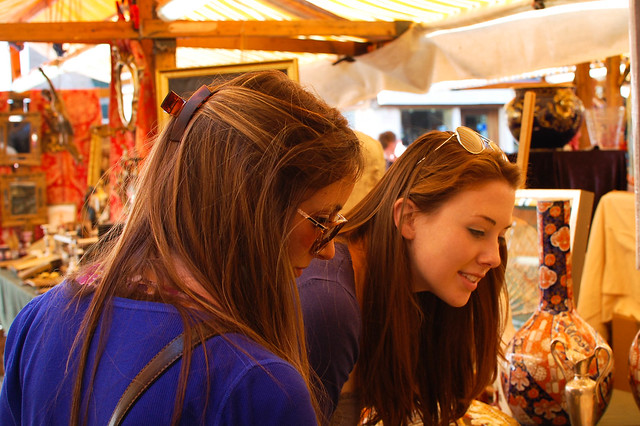
Michelle and Kendra at the open-air market in Venice. The market was a
mix of antiques and jewelry and was a real treat. 

Monday, April 11, 2011

sunny Provence

This weekend, as well as Friday, I had the wonderful fortune of taking a trip to Provence. Provence was actually most of what I saw in France the first time around so there were a few places I had been (such as Aix en Provence and Cassis - not to be confused with the fruit) but on this visit we were very much tourists and so we went to quite a few places.

The Place Wilson fountain in all its glory.
The first on our list was Orange which we visited first because it is often called the gateway into Provence. It is perhaps best known for it's ampitheatre which was built in Gallo-Roman times and is one of only three Roman theaters that still has its wall. The ampitheatre was absolutely massive  and I can imagine that seeing anything there would be pretty incredible. Orange actually holds a summer opera festival each year and though there wasn't any opera when we were there, I did spot some postcards with pictures from the festival and it looked quite impressive and memorable. Apart from the huge scale of the ampitheatre Orange and the rest of Provence was quite hot and surprisingly windy. There were several moments as we moved across the steps of the ampitheatre that I felt like I was on a White Mountain ridge on a very windy day.

The seven of us from UNH in Baux-de-Provence. From left to right:
Me, Kendra, Sean, Nick, Amy, Michelle and Kayla.
After the amitheatre we had lunch and then traveled to the town of Baux-de-Provence. On the way to the town our driver mentioned that during our journey we would pass Mont Ventoux which has been (and will be) a legendary climb in the Tour de France. I think that I was probably the only one on the bus to perk up about this but sadly while I was aware we would be passing the mountain didn't quite see which one it was. Baux-de-Provence itself sits on top of a rocky hill with a castle built into the side of it. We didn't visit the castle because admission was quite expensive but we did wander throughout the town which is largely made of stone and is half built of stone and half coming out of the hill. The building of castles and other medieval buildings has always impressed me but to build a castle out of a mountain is something else entirely. Overall the effect was that the village was extremely picturesque and though some flowers were in bloom I can imagine that in a month or two it will be quite breathtaking.

Wind chimes in Baux-de-Provence
From Baux-de-Provence we proceeded to Uzes which was where our hotel was located for both Friday and Saturday night. We didn't actually see anything in Uzes because our hotel was removed from the village but we did enjoy a meal at the restaurant. Staying in Uzes was quite different than our other trips where we stayed at hotels and then went into town and ate dinner in little groups. Due to the fact that we were all together it was quite nice to talk to some other CIEF students and play games with them afterwards without worrying about getting back to the hotel on time.

A shot of a street in Baux-en-Provence
The next day we set out to Arles. Stephane concentrated on the Gallo-Roman history of Arles but I was personally interested on its painter inhabitant: Vincent Van Gogh. After really falling in love with his paintings at the Musée d’Orsay and after reading a fictional book surrounding the last year of his life my curiosity was piqued. Sadly I cannot say I learned anything about his stay in Arles but I can definitely understand how the colors of the buildings in Arles and the many flowers in bloom (including glissine also known as wisteria) was an inspiration for him.

We, strangely enough, had the majority of our time free and so for lunch we found the massive open-air market and bought ourself a little picnic in the park. I must say that having seen a few farmers markets in New England none of them will ever compare to the French markets which seem to go on forever and ever and sell everything from charcuterie, vegetables and spices to straw-hats and cotton clothing. The market in Arles was particularly huge, easily beating Les Halles in Dijon.

The streets of Arles with an out of shot ampitheatre to the right.
After Arles we headed towards la Camargue and the Mediterranean. In Nice I had touched my feet in the same sea but thanks to an actual sandy beach I was able to go in up to my knees. With the sun beating down on our backs and my sunburn-susceptible shoulders (which came out of the weekend with color but not a burn!) it was rather refreshing. Less surprising for those of us from New Hampshire was that the Mediterranean in April was still warmer than (or a similar temperature to) the Atlantic in June or July. Camargue itself is actually a region of Provence, with Arles as its unofficial capital, but we personally visited Saintes-Maries-de-la-Mer which I may or may not have visited during my first visit to France four years ago.

Apart from a lovely view of the sea, the town and the region are famous for the horses - the Camargue- which are local to the region. The horses in particular are grey, sturdy and traditionally used for cattle work. From Saintes-Maries-de-la-Mer we traveled to Aigues-Mortes (dead waters) which is a medeival city surrounded by walls that still enclose the city today. The walls themselves are six-meters thick and were designed to be impregnable and seeing as how they still stand in excellent condition day, I gather this worked. I am relatively sure that the name of the town comes from the fact that it was at one time a major salt port and therefore near places where many things could not grow because of the salt.

The apply named Place de Vincent Van Gogh in Arles.
From Aigues-Mortes we traveled to Nimes one of the largest cities in Provence and also filled with Gallo-Roman remains including its ampitheatre, the Maison de Carée (a Roman temple) and the Jardins de la Fontaine which were built around roman ruins. Interestingly the symbol of Nimes is a crocodile linked with a palm tree. I still prefer the Dijonaise chouette (owl). Nimes was mostly a town for our dinner. We ended up being slightly in a rush and didn't end up savoring our meal as much as I (and the others) would have liked but it was still good and the warm night air was an excellent treat.

The next and final day we started with a trip to Pont du Gard, a huge aqueduct bridge which was constructed to bring water to Nimes. Like building castles into mountains, the construction of bridges is something I find mind boggling particularly when arches are involved. Pont du Gard was, before this visit to Provence, my primary thought when it came to the south of France simply because it is so iconic but now I think it's been replaced with the beautifully colored buildings, the tiled roofs and of course the heat.

For some strange reason an unfurled French flag is a somewhat rare site in
France. I think this may be due to regional pride being stronger than
national pride.
Our last visit in Provence was to Avignon. The city is quite well known for the famous Pont d'Avignon, for its theater festival in the summer and also for the period in history where it was the home of the papacy. My personal knowledge of religion and history begins with the Protestant Revolution so I won't get too into detail about how Avignon connects with the history of the Catholic Church but at one point in the 14th century Pope Clement V moved the papacy to Avignon. The popes stayed in Avignon until 1377 when they returned to the Vatican. At this same time there was also a schism in the papacy and there were as a result two popes, one in Italy and one in France. It's slightly confusing and not a subject I'm terribly interested in but because of this Avignon has a rich history and a huge Palais des Popes as well as many beautiful houses constructed for Bishops.

Pont du Gard
We had a guided tour of the Palais des Popes and then afterwards we had time to ourselves. Sunday felt very hot though I don't think it was any warmer than Friday or Saturday. Nevertheless I think we were all tired from either the heat or staying up late the night before and were quite exhausted by the time we left the city and started our 6 hour bus ride (including stops) back to Dijon.

All in all Provence was a real treat and I'm still in disbelief that in less than a week I'll be back in the Mediterranean this time in Italy!

Students playing in the river before Pont du Gard

Monday, April 4, 2011

an obligatory history lesson and the countryside

This past week was a welcome break from traveling. As wonderful as it is to travel to various places around France (and in two weeks I'll be traveling around Europe) it was nice to have a week and a weekend without too much fuss. Due to the fact that my host parents were gone last week, this week I ate with them three times (the first was normal, the second was to make up for being gone and the third was the meal I didn't get last week). The first meal, which was on Tuesday, was dominated by many subjects but most notably by talking about France during World War II.

The Place Wilson fountain on a beautiful Saturday afternoon.
This strangely enough fit in quite well with the History class I had this week wherein we covered WWII and France directly after WWII. We didn't have nearly enough time to talk about it and due to the nature of the class we focused on the politics of France during these periods. I found the entire two hours fascinating but it felt like quite a unique experience to be in a class that essentially talked about the decline and end of the French Empire which essentially began in June of 1940 when the French signed the Armistice with Germany and then set up Vichy France: an anti-semitic, anti-democratic, anti-parliamentarian government that collaborated with the Third Reich and was led by Marechal (Marshall) Philippe Petain. The Vichy government is till this day very controversial in France mostly because opinion is split between:

  • Those who argue that the government was illegitimate and established by foreign traitors, which up until the presidency of Jacques Chirac (1995-2007) was the official point of view of the French government. This point of view acknowledges the criminal behavior of the government but denies any responsibility of the French State.
  • Those that regretfully acknowledge the responsibility of the French State for its crimes. 
Given the crimes of Vichy France it seems pretty wondrous that the French Republic ended up occupying a zone of Germany, joining NATO (OTAN in French) and becoming a permanent member of the Security Council. All of this would have been impossible were it not for General (and in 1958 President) Charles de Gaulle. De Gaulle managed to escape to Britain and famously gave a radio advice on June 18th (four days before the Armistice was signed) urging the French people to continue fighting Nazi Germany. This failed but he was able to form les Forces Francais Libre (FFL; Free French Forces). For the first few years of the war de Gaulle was mostly the sole force working as a voice of Free France (an essentially illegal government). He and President Franklin D. Roosevelt quite famously shared mutual animosity for one another and de Gaulle's stubbornness constantly put him at odds with both FDR and Churchill. This is a fact that was not touched upon in this particular History class but other History classes and many documents can attest to the truth of it.

The afternoon sun streaming into my host family's apartment. 
After the Allied invasion of North Africa in 1942, the FFL dramatically increased and became largely made up of soldiers from the French colonies. These Free French Forces were then able to help with the invasion of Italy and then southern France and when Paris was liberated in 1944, de Gaulle drove near the front of the liberating forces.

Overall the history class was quite fascinating and I surprisingly learned a lot that I hadn't before. All of the history classes in which WWII is discussed rarely touch on France other than stating how in a month France was defeated and that the Vichy government was set up. I'm not sure of this is because I usually learn European history from an American or British standpoint or because after the Armistice France's role in relation to other nations was quite marginal but it was great to get the other point of view particularly when the two sides of French politics were so vastly different. 

This incredibly detailed work of art was made entirely of grains of sand
by Buddhist monks at the Buddhist temple in Burgundy.
On a subject completely unrelated to France in WWII, this weekend was completely beautiful. On Saturday there was not a single cloud in the sky and the temperature was between 70 and 80 degrees. In a word, it was incredible and I found it very odd to be receiving news of snow in New Hampshire because with such summery weather out it was weird to imagine winter still gripping NH even though I've experienced such weather many times before. Saturday ended up being a great day of relaxation and I mostly walked around town, sat in the park and read and later on had ice cream with Kendra and Michelle. 

Sunday my host father took the Swiss and I on what was basically a trip to the country side. I say basically because we made quite a few stops on the way there and back. The first was to Autun which was founded during the Gall-Roman period. Today the city still has several of the original doors, a large portion of the original ramparts and the remains of the amphitheater which was in its time one of the largest in Western Europe. In addition to stopping and seeing these particular ruins we also stopped at the town center, the Cathedral, a very ancient Pyramid that looks over the city and the ruins of a Roman temple just outside of the city.


After Autun we went to my host father's house in the countryside where we had lunch. I have to say that the French countryside is pretty picturesque and it was interesting to note that instead of rock walls dividing property, the French utilize hedges. I suppose this makes an enormous amount of sense seeing as how unlike New England (and notably New Hampshire) the French fields were not littered with an incredible amount of granite rocks. Though I'm sure the French were able to grow food much more simply without having to constantly remove rocks, there's something quite wonderful about a good rock wall.

Not too far from my host father's house was an actual Buddhist temple. Burgundy is probably one of the last places in Europe where I would think "this would be a good place for a Buddhist temple" but that didn't stop whoever built that temple from building it. Having never been to one before I didn't quite know what to expect but the temple seemed to me to be an incredible mix of color and peace. From the intricate wood carving and painting, to the peacock just walking around or to the prayer flags on massive poles or in the trees, the temple was certainly unexpected but it was also beautiful.

Prayer flags at the Buddhist temple. Prayer flags which traditionally
come in sets of 5 (one for each element) promote peace, compassion,
strength and wisdom and do not carry prayers or messages to the
gods, instead sending good-will and compassion into all of space.
They are often seen in the Himalayas.
Following the temple we preceded to the house of my host father's parents. As my host father said, the house was almost a museum in side with an array of spears, bayonets, guns, pistols and knives adorning the wall. We didn't stay inside too long because my host father's mother is quite ill but we did walk down to his brother's farm (where there were some adorable looking lambs, none of which were named 'Purple'). Further down the road from the farm were several man-made ponds with little houses built on stilts in the water. The houses (each of which sits in its own individual pond) can be rented out for about a weekend for those seeking some solitude in the French countryside.

Following this we finally headed home though not before briefly stopping at Chateauneuf which at 18h45 (6:45 PM) was closed. Given that Sunday was cloudy and a little rainy and also that we (or at least I) were tired from the day we didn't stay long but I would definitely love to come back as the village and the castle (a chateau fort) were both picturesque and authentic.

An old door in a wall at Chateauneuf.
To finish off the day I opened up the jar of peanut butter my parents sent me (thank you!) and made myself a very delicious PB&J that I'm afraid the French, not really understand just how amazing peanut butter is, wouldn't really appreciate.